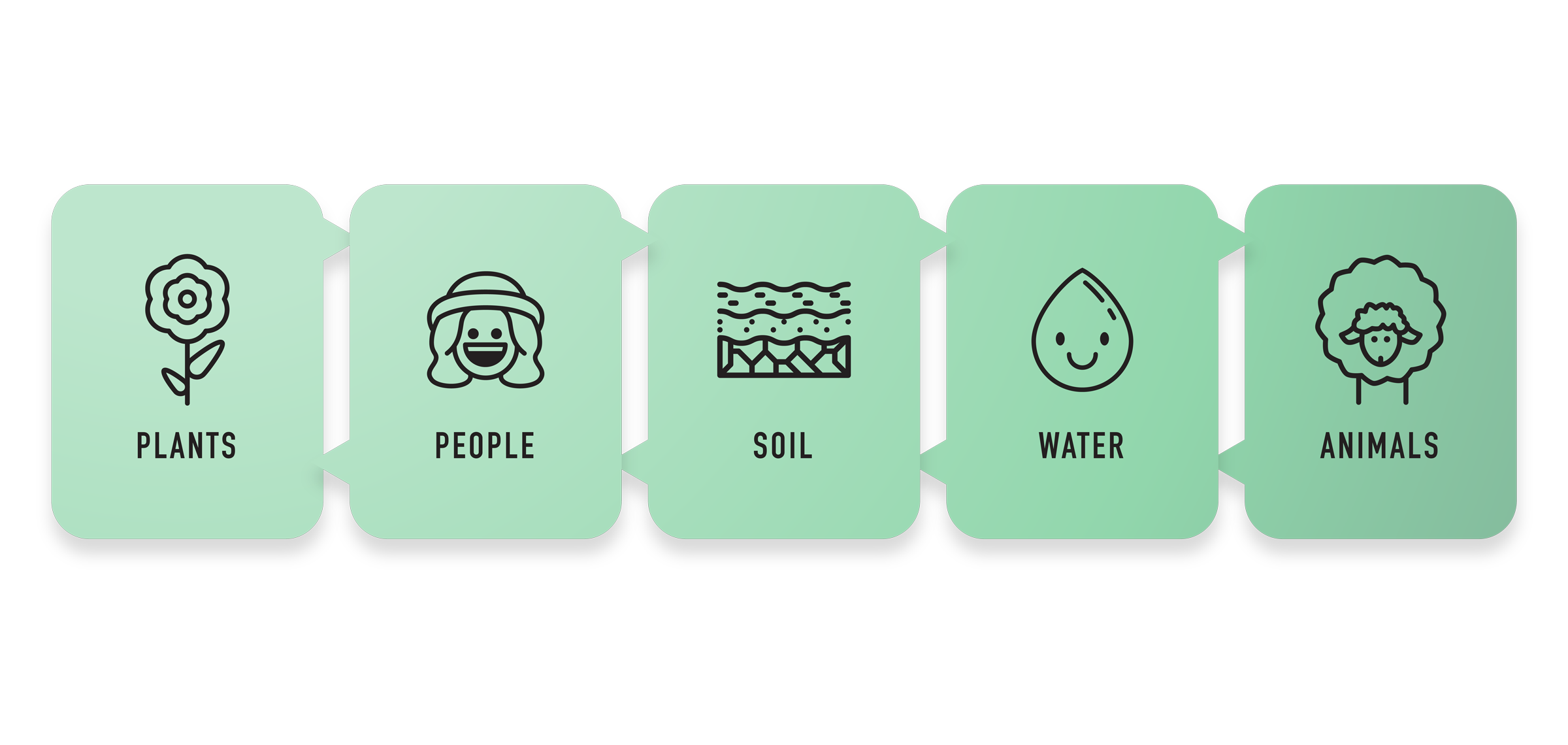
We have not had the pleasure of keeping animals on our farms to date. We have worked with a sustainable fishery to source any fish products we use. All manure that we source is from organic farms that do not use antibiotics or other harmful chemicals. We do keep worms and encourage all of our farmers to set up worm bins to produce their own castings derived from local produce. It is our belief that the earth worm develops a microbiome based on the air and environment its housed in as well as the produce its provided. Their immune system is designed over centuries to cultivate a microbiome that is beneficial to its environment and has a higher chance of generating more organic plant matter for it to consume in the future. Smarter people than us are researching this stuff, but we think this concept is worth acting on prior to randomized controlled trials.
Soil is a mixture of sand, clay and decomposing plants/animals. Withing this mixture is a complex ecology of microbes that are decomposing the organic matter in the soil. Some of these microbes have formed symbiotic relationships with plants. Certain fungi even go so far as to pierce the root wall of a plant with their hyphae, a tubular appendage. The fungi trade proteins and minerals to the plant in return for sugars.
This economy of nutrients is occurring all throughout the root ball of the plant. The microbes make nutrients available to the plant and then the plant uses those nutrients to do photosynthesis and make sugar that the plant can use to survive. The plant sends some of that sugar to its roots where it is excreted into the soil around the root, also called the rhizosphere. The plant does this in an effort to increase the activity of the microbial population and the amount of nutrients they are liberating from the surrounding organic matter. The plant is also able to release specific sugars that cultivate specific types of microbes that will create a rhizosphere that is more optimal to the plant.
In regenerative agriculture our goal is to facilitate that exchange of energy and provide the limiting factors in the equation. A limiting factor is a part of a process that limits the amount of something that can be produced. In the case of cannabis it is often a specific mineral that causes severe issues. These mineral issues are easy to avoid by keeping the ph of the soil in a reasonable range and testing the soil a few times a year to identify excess or deficiencies that need to be addressed. While not crucial, good data is the most valuable tool a farmer can have going into a new season.
During the process of balancing the soil pH and mineral content we also optimize the carbon to nitrogen ratio. There are a lot of important ratios in the soil web and its hard to say which one is the most important. Carbon and nitrogen have a relationship that as you increase one you should increase the other. The dead roots from your previous seasons cover crop and the decomposed leaves are a great way to increase the carbon content of your soil. Using biochar is natures secret to quickly increasing the carbon content of your soil.
We have primarily grown with manure and fish emulsion as our sources of nitrogen. The soil ecology likes to digest the complex molecules that make up manure. Kelp extracts and earth worm castings are a great boost to the ecology when available, but not necessary to produce a good crop. Having enough carbon in your soil to handle the manure you are adding is fundamental to regenerative farming.
One way to enhance the carbon that is in your soil is to add Actively Aerated Compost Teas(AACT) to your water during irrigation. These teas increase the microbial population in the soil and enhance the creation of humic and fulvic acids. Humic and fulvic acid are chelators that allow for the mineral in your soil to be more available to the plant. These molecules also help to form soil aggregates which trap carbon and water increasing soil health.
There are lots of organic inputs that can be added to your soil and it really comes down to cost and availability. We would like to see a world where farms are able to source all of their inputs from local sources. This will take a different approach to land utilization and farming practices. It will not be an over night process, but there are farms who have achieved this, so we know its possible and it should scale.
Plants are the conductors of the whole operations. If you provide good soil and a harmonious composition of plants, the chances of something killing your crop are much lower. Even against a threat like hail, the thicker stems and faster recovery time can allow you to still reap a bountiful harvest even after a bad hail storm. In 2017 we had this occur and lost about half the height of our crop. The plants didn’t miss a beat and started bushing out and making use of the structure they still had.
We are lucky the cannabis is such a strong plant. Its still always worth using genetics that are breed for your area. There is a large difference amongst genetics in their insect and mold resistance. This is also true of cover crop and companion plant genetics. We can help you find tried and true suppliers of cover crop genetics.
All of our farms implement different water management practices to help stop erosion and slow the speed of the water across the land. Small changes to the landscape can drastically change the amount of water that is retained by the land. Swales, trenches, and French drains are large investments that yield returns over many years.
Across the land we plant cover crops, which are a mix or grasses, clovers, and other fast growing plants. These plants have different root structures which creates a maze of pathways for water to travel deep into the soil. By combining this with water saving irrigation methods, we are able to be more efficient with the water we do have to extract from a well.
Farming is hard work. To scale these practices takes a team of dedicated people. The farm must be a safe and fun place to work. Farming doesn’t have to be physically demanding at all time or for all people. There is an opportunity with technology to enable a more diverse set of individuals to produce our food and leverage the innovations from the last few centuries to heal the soil. Providing a meaningful mission, a safe and fun work environment and an above average wage is what is required to make farming truly regenerative for everyone involved.
Get the latest news about our regenerative farming initiatives.